Archive for May 4th, 2009

Photocinema Conference

Monday, May 4th, 2009

The Photocinema Conference took place at Quad, Derby on March 6th as part of FORMAT 09 Festival. It took the form of a one-day symposium around the theme of the still and moving image.

The conference was sold out well before the day not least because of the varied line-up of speakers, which intelligently combined talks by practitioners with those of theorists/academics.

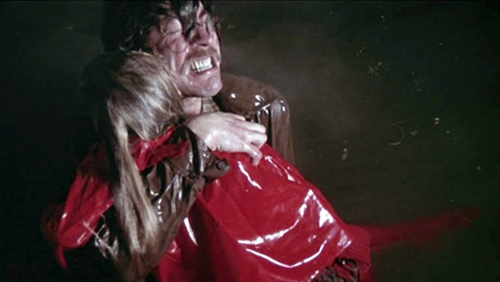
David Campany took the floor first and introduced the audience to a series of photocinema encounters. This included the use of a colour transparency in the opening scenes of the film Don’t Look Now, (based on the Du Maurier novel) which begins to seep blood as Donald Sutherland views it on a lightbox. The sight prompts a premonition of tragedy in Sutherland, that of the drowning of his daughter, itself a premonition of the macabre events which follow.
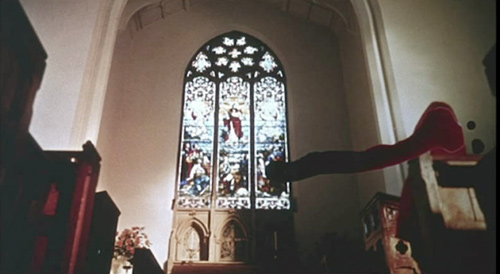
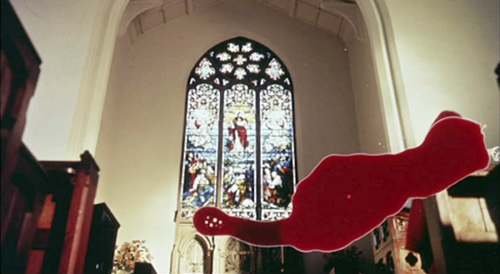
Don’t Look Now

Don’t Look Now

Don’t Look Now

Another powerful reference was to the shot for Victor Sjostrom’s 1927 film The Wind. Used as a production still, this stunning image was in fact a staged reconstruction but has exactly the energy and movement appropriate to the subject of the film.
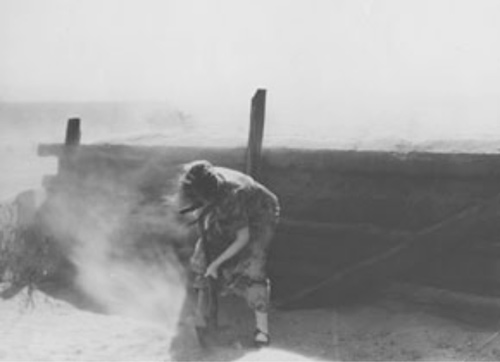
The Wind

This interplay of stillness and movement, where sometimes one medium succeeds in doing that which the other is renowned for, was the underlying thread through all the presentations that followed.

On the theme of the elements still, Martin Parr showed a wonderfully candid short on a stormy evening in one of England’s tired but chirpy coastal holiday resorts. While Victor Burgin showed the last 7 minute sequence from Antonioni’s L’Eclisse. Shot on the corner of a quiet street as the sun sets, this astonishing series of scenes in which little more happens than time passing, is a film-makers homage to stillness.

There were too many highlights for me to cover them all. Neil Campbell presented a fascinating paper on the work of Robert Frank and Wim Wenders, one a photographer whose work functioned more like a film (in “long sentences” said Kerouac), the other a film-maker whose films can be read as a series of stills. Donovan Wylie gave a frank account of his crisis with photography and his frustrations with film-making, both informing work which is in my opinion more engaging for the struggle. Eric Baudelaire talked of the influence of Tarkovsky’s Stalker in his work Imagined States (2005). Finally Rachel Moore presented Hollis Frampton’s 1971 film nostalgia. An important film in an art historical sense no doubt, but one which really should not be scheduled for the end of a long day’s listening.

All in all though this was an exciting day, both informative and inspiring, with photography shedding light on cinema and vice versa, neither loosing their magic through association. I could have done with a little more female magic in the line-up of speakers but that would be my only criticism. This is an area of intrigue for me and I had a great day watching and listening to the various pieces of an ongoing puzzle.

EJ. Major

EJ Major is an artist based in London. Her solo exhibition ‘Try to Do Things We All Can Understand’ was premeried at Street Level in April 2008, and coincided with Glasgow International. The work of the same name was also included in the FORMAT 09 festival exhibition at Quad, Derby.
Photography in Scotland: Then, Now and Beyond Our Time

Monday, May 4th, 2009

The Scottish Society for the History of Photography

National Galleries, Edinburgh 28th March 2009

SSHoP Conference

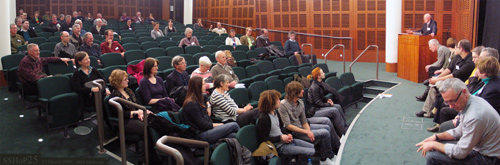
The conference celebrated the 25th anniversary of The Scottish Society for the History of Photography. The first meeting in 1983 was held in order to raise awareness of photography’s potential as an art form. This fuelled the original members’ decision to start a BA Honors course dedicated to Fine Art Photography at The Glasgow School of Art. From then on, the Scottish impact on photography became worldwide and a vibrant photographic culture was finally realised.Various themes ran through the day’s discussion such as photography’s ability to lie, or perhaps more accurately the photographer’s desire to lie. Also discussed were the effects of the progression of technology in photography and the uncertain future of this medium.Certain questions arose both from audience members and speakers such as ‘What sort of photography will there be in the next 25 years?’ Considering the relatively short lifespan of the medium and its dramatic technological progression in the last 30 years, only hazardous guesses were made. Nothing is certain with the future of photography but I find this prospect rather exciting.

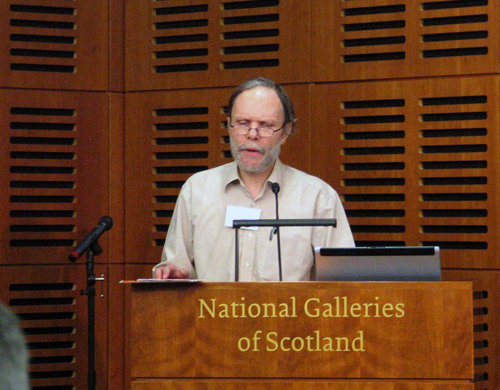
SSHop talk 1

It was made clear from the artist talks by Calum Colvin and more specifically the New Generation photographers that not all has been lost to digital photography. In fact 3 of the four artists referred to the delights of the flourishing second-hand market of film cameras. I remain positive that whilst technologies in photography will continue to develop at lightning speed, both young and older photographers will strive to keep mechanical photography alive. A perfect example of this is New Generation photographer, Lucy Levene, who when asked about the future of photography mentioned that she has recently set up her own commercial darkroom.One topic arose that interested me was in the future of photography as a career. With the number of graduating photographers in the UK each year being significantly larger than the number of jobs in the photographic industry in the whole of Europe, one lady asked if this can possibly be sustained. What will happen to all these photographers?

SSHop talk 2

Dr Sara Stevenson, a leading member of the SSHoP since 1983, spoke of the common pursuit of collecting photographs simply due to an aesthetic appreciation. This human adoration of photographs is what I believe has caused a dramatic increase in those studying photography but will engender the development of subcultures and new ‘isms’ within photographic art…also provide us with the next generation of photography.  The question was asked with uncertainty and worry rather than excitement for the future of the great medium and its followers. Three snapshots into the lives and portfolios of three New Generation photographers was more than enough to convince me that the future is not necessarily bleak.Each artist delivered a short presentation on their most recent work and personal practice. All three varied in subject matter and style though themes that were conveyed through their photographs overlapped considerably, such as disability, faith, immigration, and globalisation. There seemed to me to be an ultimate focus on contemporary culture and observations of Scottish society.

SSHop talk 3

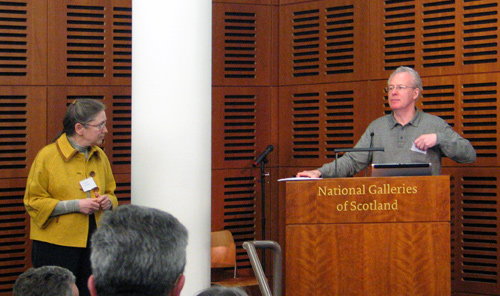
I found the three artist talks tremendously inspiring and reassuring. I believe that if there are fine art photographers, they will continue to produce work whether they are getting paid to do so or not. It is a genuine love of photographs and the communication through them that inspires each of us to continue making art this way. The conference was held on 28 March 2009 at the Hawthornden Lecture Theatre, National Galleries of Scotland, Edinburgh. Speakers were David Bruce, Dr. Sara Stevenson, Dr. Alison Morrison-Low, and David Brittain.Artist Talks from Calum Colvin, Andy Wiener, Claire Wheeldon, Michael Mersinis and Lucy Levene.

Victoria Baker

Victoria Baker is a photographer based in Glasgow. She was included in the ‘Futureproof’ exhibition at Street Level in late 2008, an exhibition showcasing some recent talent from photography courses at Scottish art schools.

Photographs courtesy of Roger Farnham.

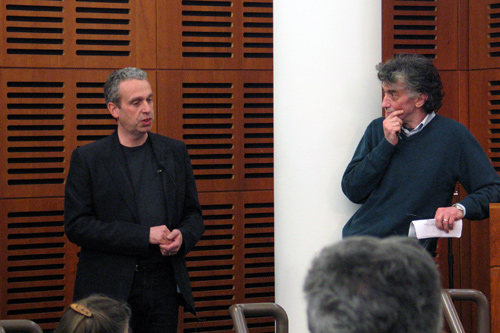
Donovan Wylie at PhotoCinema

Monday, May 4th, 2009

To me a festival like FORMAT and the recent PHOTOCINEMA conference in particular is a hub for all these supremely creative people to get together and feed off each other’s talents. It feels like home. It doesn’t matter how well I know a photographer’s work – to me there is nothing like hearing them talk about the “behind the scenes”. This is when one has an opportunity to appreciate their personality and truly connect with the artist’s world.

I found Magnum photographer Donovan Wylie’s presentation most inspiring as he struck me as a deeply sincere person who seems to say only the things he strongly believes in. He is a brave, decisive and reliable narrator who takes great responsibility in expressing his view without prejudice.

His ease and honesty in telling the story behind his BAFTA winning film “The Train” were very refreshing. He clearly left his safety zone – photography, and began an adventure with a highly collaborative craft of moving image. He experimented, inventing his own way of telling a story.  (It brought to mind the Bell chapter in Tarkovsky’s  “Andrei Rublev” with a boy who mobilised a crowd of people claiming he knew the secret of bell casting. After the extremely laborious task was complete and the bell rang perfectly we find out that the boy didn’t know a thing about it and relied primarily on faith and his natural skill…)

In “The Train” Donovan geographically and emotionally explores modern Russia which intrigued me – as a Ukrainian photographer living in the UK I am yet to photograph Britain in spite of my huge curiosity for its inner life. I always considered interpreting such a different culture a dangerous territory: how do you deal with something so unfamiliar without trivialising it? Looking at the “Western” work on the former Soviet Union I often find it exciting but feel that it’s all about surface and it tells me nothing through its obsession with detail and recycling of exhausted characters.  A lot of it seems to be revolving around the exotic, which is certainly very seductive and can become a license for patronising. Donovan Wylie however brilliantly succeeded in seeing through the exotic glamour that so often sticks to the subject. I don’t know whether he managed to find his deeper meaning at the end of the journey through Russia, but to me he clearly found a real ambivalence which resonates way beyond state borders.

Alina Kisina

Alina is a self-taught Ukranian photographer who trained as a linguist. Her solo show ‘Zerkalo : Mirror’ was shown at the Scotland-Russia Institute in Edinburgh in December 2008 to January 2009.

Photography and The City

Monday, May 4th, 2009

Stills Gallery, Edinburgh, 6th March 2009.

This event was advertised as a discussion that would explore the themes of photography and the city through distinct perspectives.  Indeed, Alex Law, Duncan Forbes and Francis McKee approached the subject from three very different points of enquiry.

Alex Law began the discussion by offering us a look at 20th Century social theory through the work of Walter Benjamin, Henri Lefebvre and Georg Simmel.  His paper was insightful, and surprisingly more relevant to photography than I had anticipated.

Law discussed Simmel’s The Metropolis and Mental Life (1903) and how the urban environment has transformed our personality over the years through the adjustments the city imposes on people.  His talk covered broad themes, including the visual imagination of the city, the bombardment of our senses, the dialectic of the city, the domestication of the street and more generally, modernism and modernity.

Law outlined the inherent tensions between commodity production and people’s values and individuality.  He touched upon Marx to illustrate that to make sense of history, we must leave the world of surface appearances and ideology and instead examine the material realities of labour and the dissemination and control of information if we are to obtain the ‘truth’. Importantly, Law discussed the idea that experience itself is becoming devalued, and that many thinkers (from Simmel to Adorno) believed that Art is the solution to the rescue humanity from experience.

Benjamin was one of these thinkers who saw art positively.  For example Benjamin argued that with advances in technology such as photography, there is increased scope for human agency in the creation of art works.  Yet in many ways this put him at odds with the pessimism of Adorno’s critique of the culture industry, and its standardisation of the production of art works.

Duncan Forbes went to offer us a reengagement with the history of photography.  He focused on picturesque Edinburgh, the politics of the structural nostalgia and the romantic imagery this enforces.  He outlined that in the 1820s there was an explosion of images of the city. Edinburgh was emerging as a ‘spectacular city’, and according to Forbes this ‘spectacular’ had a dramatic effect on social relations.

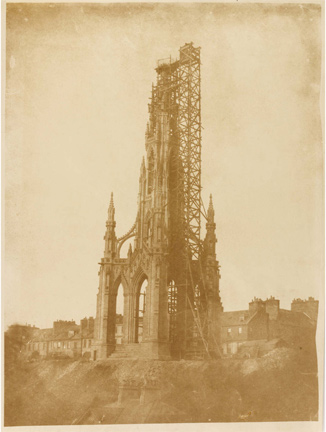
Forbes described the arrival of the camera as a revolutionary instrument.  Through an intriguing slideshow of photographic calotypes we were offered a very different view and representation of Edinburgh compared to the romantic paintings we had seen previously.  We looked at the work of Hill and Adamson, who (I had not realised) had paid particular attention to Edinburgh’s architecture.  In fact, Forbes informed us that Hill was actually a very political figure who was part of a massive attempt to reclaim art from the aristocracy.

Figure 1

Figure 1: Edinburgh’s Scott Monument Under Construction, c1844David Octavius Hill and Robert Adamson.

Through this new photographic documentation of Edinburgh’s architecture, the city was being actively monumentalised.  Edinburgh was transforming rapidly.  Capitalism was now firmly entrenched as the dominant system of production, and thus changes within the local environment were inevitable: urban demolitions were common. In turn, the increasing rationalisation of modernity, as famously depicted by Max Weber, became entrenched in photography – the romanticisation of the past went hand in hand with its increasing commodification through the medium of photography.  Forbes quoted Benjamin in saying that ‘the truth of an object is only visible in its destruction’.  This discussion of destruction led us on nicely to Francis McKee’s paper.

Francis McKee offered us a discussion based on his current interest in the internet, modern ruins and their relationship to photography. McKee illustrated his talk with images of modern ruins from internet sites to demonstrate their increasingly popularity as an ‘internet genre’.

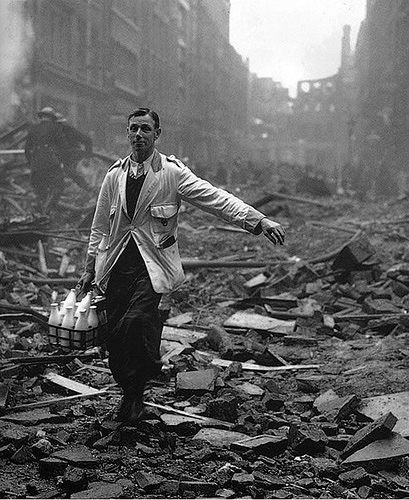
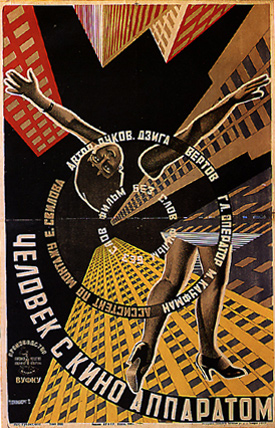
He spoke about the ruin as a modern invention that we humans have a great unspoken excitement and fascination with.  His talk looked at various artists who have been inspired by ruins, from writers who remarked at the ‘dark and wonderful’ nature of the Blitz, to filmmakers who were inspired by bombed-down cities to make movies (known as ‘Rubble Films’).  He also analysed more recent examples of photographers who engaged with ruined sites such as Chernobyl, Beirut, Ground Zero and contemporary Detroit.  McKee rightly questioned why people are so interested in these types of ruins. Where is photography now?  And how is photography related to these sites?

 Figure 2

Figure 2: Getty Caption: ‘A milkman delivering milk in a London street devastated during a German bombing raid. Firemen are dampening down the ruins behind him.’  Photographer Fred Morley.

 Figure 3

Figure 3: Original film poster for Rubble Film, c, 1929, Man with a Movie Camera

 Figure 4

Figure 4: Michigan Central Train Station, Detroit. Image taken from the  Internet site Flikr

McKee argued that the ruin might be becoming a fetishised symbol for photographers as a reaction to hyper media.  Indeed as a photographer, I fully appreciate the temptation to document these ruins as they some how seem to encapsulate the past and present simultaneously.

The discussion ended on the somewhat depressing note that our experience of the city is becoming increasingly mediated, and that Art and photography still shape our imagination of the city.  Some say that the city is dead – yet McKee also suggested that maybe photography is dead.  Today, we occupy a whole new social way of taking and receiving photographs. Controversially McKee suggested that maybe this new currency is much more important than Fine Art Photography. Although this was a somewhat pessimistic point to end on, it is a challenge for us photographers to grapple and engage with…

Caroline Douglas

Caroline Douglas is an artist based in Glasgow who predominantly works with photograpy. She was Artist in Residence at Stills Gallery in Edinburgh in 2008. She graduated in 2006.